Christina Drill interviews editors S. Afzal Haider and Elizabeth McKenzie

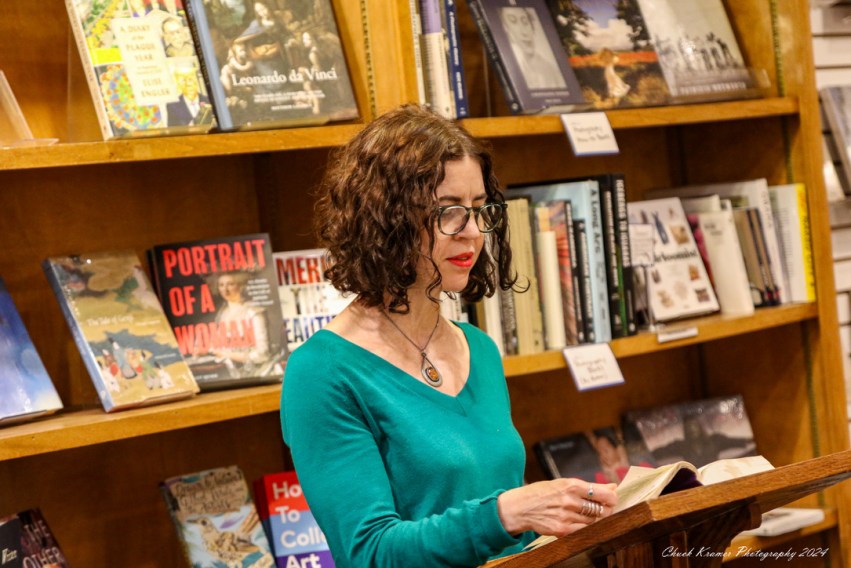
The Chicago Quarterly Review celebrated its 30th anniversary and other recent issues as well as the release of founder S. Afzal Haider’s new collection The Dying Sun and Other Stories at The Book Stall on September 29.
from left: Gary Houston, Faisal Mohyuddin, Eleanor Spiess-Ferris, Signe Ratcliff, S. Afzal Haider, Dipika Mukherjee, Chuck Kramer




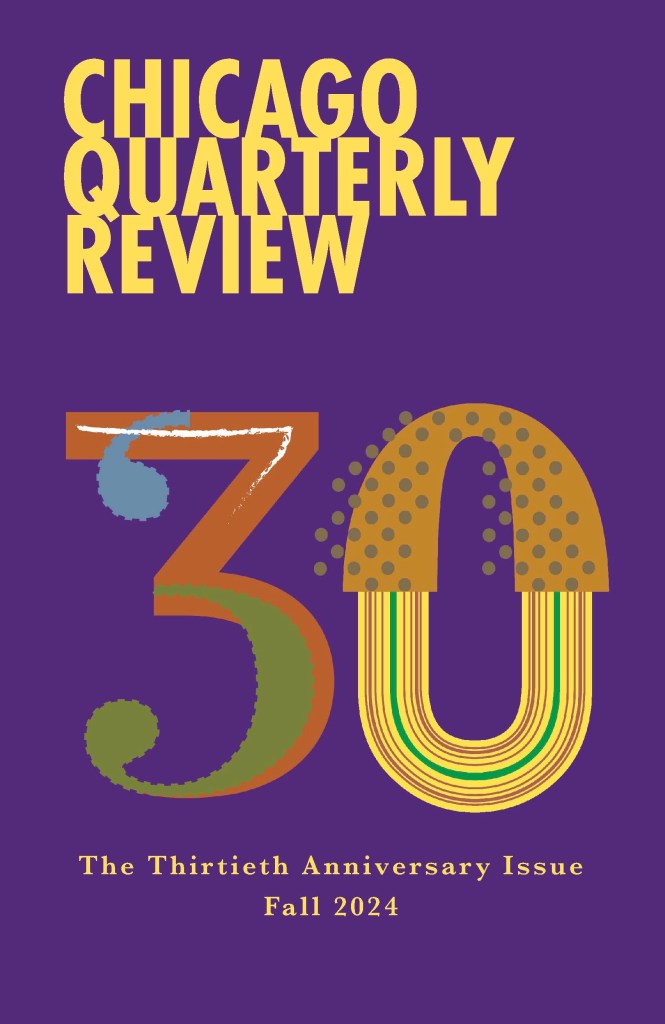
The CQR celebrated 30 years in print on September 5, 2024 at City Lit Theatre in Chicago.
Back row, left to right: Miles Harvey, LeVan D. Hawkins, Suzanne Scanlon, Mary Wisniewski, Gary Houston, Richard Huffman, Charles Kenney, John Blades
Front row, left to right: Signe Ratcliff, Aarti Monteiro, Olga Domchenko, Elizabeth McKenzie, S. Afzal Haider, Jeff Wolf, Ben Bird, Chuck Kramer


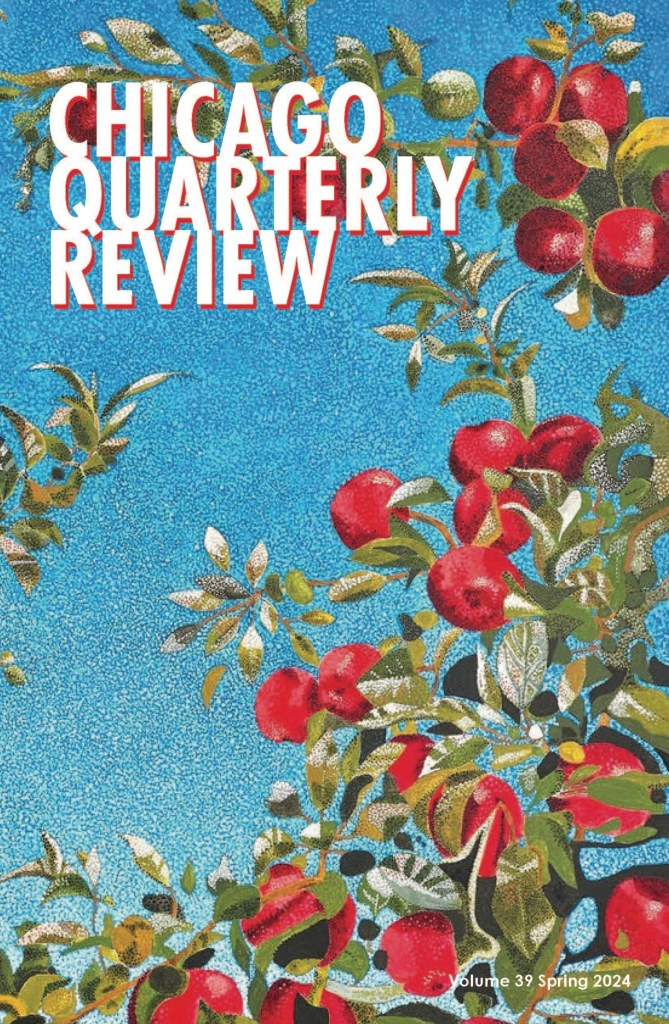
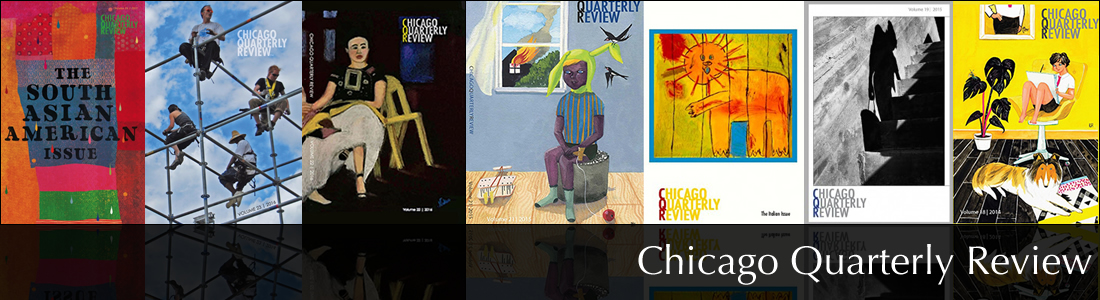
With cover art by Liz Radford and featuring work by: Dawn Abeita * Bipin Aurora * Scott Brennan * Sinclair Cabocel * Don Clermont * Lisa Compo * Johnny Cordova * Alida Dean * Kenneth Gangemi * Lee Matthew Goldberg * Eleanor Goodman * Ryan Kristopher Jory * Mickie Kennedy * Davíd Lavie * Terri Lewis * Oksana Maksymchuk * Juan Martinez * Michael Mattes * Dipika Mukherjee * James Stuart Nolte * Matt Poindexter * Jessica Bell Rizzolo * David Ryan * Kim Samek * Kirstin Scott * Sarah Seybold * Murzban F. Shroff * Nicole Simonsen * Christine Sneed * Jake Spears * Marcus Spiegel * Glenn Taylor * Raymond Thompson Jr. * Lauren K. Watel * Ian Randall Wilson * Tanya Žilinskas

 Featuring work by: Melissa Andrés * Justin Aoba * Harold Bordwell * Anna Braverman * Finn Briscoe * Paola Bruni * Marisa Campbell * Xochiquetzal Candelaria * Maria Castell-Greene * Morris Collins * George Cotkin * Kwame Dawes * Shawna Ervin * Paul Farwell * Gustavo Pérez Firmat * Rebecca Fox * Sekyo Nam Haines * Morgan Hamill * Miles Harvey * Dennis Hauck * Cho Ji Hoon * Gloria L. Huang * Jesse Lee Kercheval * Luke Johnson * David Philip Mullins * Sarah Nance * Natalia Nebel * David Nikityn * Lauren Page * Hearne Pardee * Roy Parvin * Michael Pearce * Jessica Powell * E.I. Pruitt * John Robinson * Ed Ruzicka * Daniel Saalfeld * Neal Snidow * David Susman * Nathan Winer * Reggie Scott Young * Annie Zhu
Cover art: “Waterville” by Hearne Pardee
Featuring work by: Greg Ames * rose auslander * Drew Calvert * Harrison Copp * Mark Crimmins * Dante Di Stefano * Michael Downs * Patrick Dundon * Josh Emmons * Philip Eskenazi * Kirk Glaser * Justin Groppuso-Cook * Colton Huelle * Richard Huffman * Richard Jacobs * Stephen Earley Jordan II * Markus Kirschner * Amy Marques * Jessie Ren Marshall * Paddy McCabe * Eireene Nealand * Pablo Neruda * Kristy Nielsen * Jack Norman * Darren Oberto * Marcus Ong Kah Ho * Andrew Porter * Melissa Pritchard * Orel Protopopescu * Jessica Nirvana Ram * Tim Raymond * William V. Roebuck * Malcolm Rothman * Varun U. Shetty * Paul Skenazy * Wally Swist * Ernie Wang * Thomas Wawzenek * Maud Welch

Come visit us at Booth #232!

We’re thrilled for our contributors Rita Dove and LeVan D. Hawkins, who have been awarded Pushcart Prizes for their work in CQR #33, and for A.D. Nauman (CQR #34) and David Nicholson (CQR #33), given Special Mention in the 2023 Pushcart Prize Anthology!


Congratulations to our contributors who’ve been recognized this year in Best American Short Stories and Best American Essays!
—Cliff Thompson, whose essay “Ming Yang Fu, Or Seeking Words at Age Thirteen” from CQR #33 has been named a Notable Essay of the year by Best American Essays 2022!
—Jerald Walker, whose essay “An American Right” from CQR #33 has been named a Notable Essay of the year by Best American Essays 2022!
—Rachel Eliza Griffith, whose story “Miracle River” appeared in CQR #33 and has been selected as a Distinguished Story of the year in Best American Short Stories 2022!
—A.D. Nauman, whose story “The Cat” from CQR #34 has been named a Distinguished Story of the year in Best American Short Stories 2022!


Featuring work by: Chris Arp * Jennifer Bannan * Keri Bentz * Barbara Blades * Alan Bodnar * Jessica Breheny * Ricardo Cazares * Jinwoo Chong * Stephen Cramer * Jose Hernandez Diaz * Kerry James Evans * Shannon Fandler * Mohan Fitzgerald * Stephen Gibson * Henrietta Goodman * Benjamin S. Grossberg * Joe Imwalle * Juan Ramón Jiménez * Elizabeth Kadetsky * Scott Karambis * Peter Kessler * Chuck Kramer * Dorianne Laux * Brian Ma * Ken Malatesta * Michael Milburn * Julie Murphy * Devin Thomas O’Shea * Zack Rogow * aureleo sans * Lisa Sardinas * Devin Schiff * David Sheskin * Scott Spencer * Wally Swist * Sara Truuvert * Gemini Wahhaj * Charlie Watts * Ian Randall Wilson * Laura Budofsky Wisniewski
Cover image: “Puzzle” by Barbara Blades


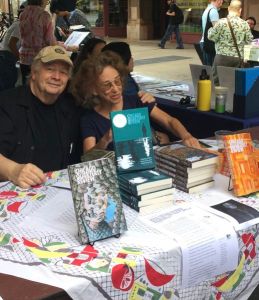

Come visit the editors at the Chicago Literary Hall of Fame tent, September 10 & 11, 2022


Featuring work by: Prad Aphachan * Ann Voorhees Baker * A. J. Bermudez * Anthony Berris * Sheldon Costa * William C. Crawford * Alicia DeRollo * Terri Drake * Mark Duncan * Banzelman Guret * Barbara Haas * Charlie Hahn * Stephanie Hayes * Gary Houston * Ulrica Hume * Amy Kiger-Williams * Federico Garcia Lorca * Michelle Massie * Michael Mattes * George McDermott * Sam Meekings * Jane Morton * Dipika Mukherjee * Jan Nakao * Yoram Naslavsky * E. Nolan * Jack Norman * Ann Pedone * Matt Polzin * John Robinson * William Roebuck * Malcolm Rothman * Andrew Schofield * Susan Shepherd * D. James Smith * Wally Swist * Kristine Thatcher * Michael Trocchia * Francis Walsh * Whitney Watson
Cover: “Labyrinth” by Jan Nakao